
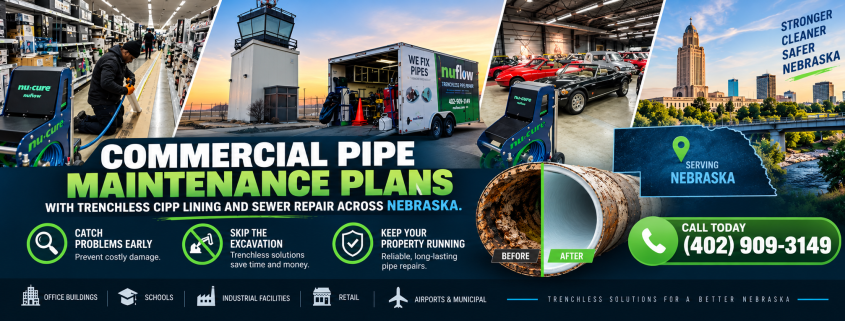
The Cheapest Pipe Repair Is the One You Never Need
I had a conversation with a school superintendent last spring that stuck with me. He’d just gotten a quote to replace a collapsed sewer main underneath the cafeteria wing of an elementary school. The number was north of $300,000. The work would take three weeks. They’d have to relocate two classrooms, shut down the kitchen, and bus lunch in from another school across town until the job was done.
He looked at me and said something I’ve heard a hundred times now. “If somebody had told me five years ago I could’ve caught this for a few hundred bucks, I would’ve done it in a heartbeat.”
That’s the whole story right there. That’s what this blog is about. Not selling you a service — just telling you something that most building owners don’t hear until it’s too late.
The cheapest pipe repair is the one you never need. And the way you avoid needing it is embarrassingly simple. You look.
Most Buildings Run on Plumbing Nobody’s Checked in Decades
Think about everything that gets inspected in a commercial building. Elevators. Fire suppression. HVAC. Roofing. Electrical panels. Sprinkler systems. Every one of those has a schedule, a vendor, a sticker with a date on it.
Now think about the pipe system. The sewer mains, the branch drains, the underground lines carrying waste and water out of the building every single day. Who’s checking those? When’s the last time anyone looked inside one?
For most buildings, the answer is never.
And it’s not because people are careless. It’s because for a long time, the only way to inspect an underground pipe was to dig it up. Nobody’s going to do that as a preventive measure. So the industry just accepted that pipes were something you dealt with when they broke — not before.
That’s not the case anymore. A high-def video camera can run through your entire pipe system in a few hours through existing cleanouts and access points. No digging. No disruption. You get a full video and a written report showing every inch — cracks, corrosion, root intrusion, joint separations, buildup, all of it. And you find out what you’re dealing with while there’s still time to plan around it instead of react to it.
That inspection is the foundation of a maintenance plan. And a maintenance plan is the thing that keeps a $300 investment from turning into a $300,000 emergency.
What a Commercial Maintenance Plan Actually Is
I want to strip away the marketing language for a second because “maintenance plan” can sound like something someone’s trying to upsell you on. It’s not. It’s actually the most boring, practical thing in the world. And that’s exactly why it works.
A maintenance plan is a schedule. That’s it. Based on your building type, your pipe age, what’s running through your drains, and how many people are using the system — we set up a recurring calendar of camera inspections and preventive cleanings. Could be annual. Could be quarterly if your building puts heavy demand on the system. We run the camera, document what we see, compare it to the last inspection, and flag anything that’s changed.
When something shows up — and eventually something always shows up — you catch it when it’s a hairline crack instead of a full break. A root tendril poking through a joint instead of a root ball blocking the whole line. A thinning section of cast iron instead of a corroded-through hole dumping sewage under your slab.
At that stage, the fix is small. Targeted. Affordable. You schedule it when it works for you and your building keeps running the whole time.
Without the plan, you find out about that same problem six months or two years later when it’s ten times worse and there’s sewage backing up into your building on a Tuesday morning. Now you’re in emergency mode. Now you’re paying emergency prices. Now your building is disrupted and you’re explaining to your board, your tenants, your patients, or your students why the building smells like a sewer.
The plan doesn’t prevent pipe aging. Pipes age no matter what. The plan just makes sure you’re never surprised by it.
Why Trenchless Repair Changes the Math on Maintenance
Here’s the part that makes all of this actually work for commercial properties. Even ten or fifteen years ago, catching a pipe problem early didn’t always help that much — because the repair itself was still a nightmare. Traditional pipe replacement meant digging a trench, tearing up whatever was on top of the pipe, pulling out the old line, laying new pipe, backfilling, and restoring the surface. In a commercial setting that could mean cutting through parking lots, sidewalks, concrete slab foundations, landscaping — all of it. The disruption alone was enough to make some building owners say forget it, we’ll deal with it when it breaks.
Trenchless pipe and sewer repair changed that completely. Now when a maintenance inspection catches a problem, we can fix it from the inside without touching the surface. We access the pipe through existing cleanouts or access points, and we line it from the inside using a process called CIPP — cured-in-place pipe lining.
CIPP works like this. We clean the damaged section, insert a flexible liner saturated with epoxy resin, inflate it against the pipe walls, and cure it in place. When it hardens you’ve got a brand-new pipe inside your old one. Seamless. Jointless. No entry points for roots. No seams to corrode. The liner is actually stronger than most of the original pipe materials it’s replacing, and it carries a 50-year expected lifespan.
For a commercial property, that means a problem caught during a routine maintenance inspection gets repaired in one to three days with no excavation, no property damage, and no operational shutdowns. Your school stays open. Your production floor keeps running. Your tenants don’t get displaced. Your parking lot stays intact.
That’s why maintenance plans make so much more sense now than they did a generation ago. Finding a problem early used to just mean knowing about it sooner — the fix was still going to be ugly. Now finding a problem early means fixing it quietly, affordably, and on your schedule. The whole equation is different.
The Buildings That Need This Most
Every commercial building with underground pipes benefits from a maintenance plan. But some buildings burn through their pipe systems faster than others, and those are the ones where skipping maintenance is the most expensive gamble.
Schools push enormous daily volume through aging systems — hundreds or thousands of people using restrooms, kitchens, and water fixtures every single day. Most school buildings in Nebraska were built in the 50s, 60s, and 70s, which means they’re running on pipe materials that were designed to last 40 to 50 years. We’re past that window. And a pipe failure at a school doesn’t just cost money to fix — it costs instructional time, parent confidence, and administrative sanity.
Food processing and manufacturing plants have the added pressure of regulatory compliance. USDA and FDA standards require sanitary drainage conditions at all times. A cracked or deteriorating pipe under a production floor isn’t just a plumbing problem — it’s a compliance risk that can trigger inspections, shutdowns, and recalls. Documented maintenance records showing regular camera inspections and preventive care are exactly what an inspector wants to see.
Restaurants and hotels put relentless demand on their drain systems. Grease, food waste, high water volume, constant use — these systems wear faster than almost any other commercial application. A backup during service or a sold-out weekend doesn’t just cost you the repair. It costs you the customers who don’t come back.
Hospitals and healthcare facilities operate in a world where shutting down for pipe repair isn’t an option. Patient care requires functioning plumbing, and construction activity inside a healthcare building introduces contamination risks that go way beyond inconvenience. Maintenance keeps the system stable. Trenchless CIPP repair handles problems without the dust, noise, and disruption of excavation.
Apartment complexes and managed properties run shared pipe systems where a single main line failure can take dozens of units offline. Displaced tenants, emergency housing costs, and lease complications pile up fast. A maintenance plan is the landlord’s best protection against all of it.
Warehouses and industrial buildings are the quiet risk. These buildings feel indestructible, but their pipes are the same age and same materials as every other building in town. And when a pipe fails under a warehouse slab, accessing it through traditional excavation means cutting concrete, moving inventory, and shutting down operations. A camera inspection through existing cleanouts takes a few hours and costs almost nothing by comparison.
The Real Cost Comparison
I’m not going to throw a bunch of hypothetical numbers at you. Here’s what I see in the field every month.
A commercial camera inspection runs a few hundred dollars depending on the size of your system. A maintenance plan that includes scheduled inspections and preventive cleaning is a predictable monthly budget item — not a windfall expense, just a steady cost you can plan around.
A commercial sewer line failure with traditional excavation runs $150,000 to $500,000 depending on the scope, the depth, what’s on top of the pipe, and how much surface restoration is needed afterward. That’s before you add lost revenue from downtime, tenant displacement costs, regulatory fines, or insurance complications.
Even if your maintenance plan catches a problem that needs a CIPP repair, the lining typically runs 30 to 50 percent less than traditional dig-and-replace — and you skip all the collateral damage costs because nothing got dug up.
The math isn’t complicated. It’s just a matter of whether you do it before or after something goes wrong.
September Is the Right Time to Start
If you’re reading this in September, you’re in the sweet spot. Summer’s winding down. Schools are back but still settling in. Production schedules are steady but not yet at holiday peak. Hotels haven’t hit their fall booking surge yet. There’s still time on the calendar to get an inspection done, review the results, and set up a plan before the end of the year — without competing against a crisis.
Every building owner I’ve worked with who started a maintenance plan says the same thing. I should’ve done this years ago. Not because something terrible happened, but because the peace of mind alone was worth it. Knowing what’s underneath your building — and knowing someone’s watching it — changes how you sleep at night.
If you’ve never had your pipes inspected, start there. One inspection. A few hours. A clear answer. And if everything looks fine, great — you bought yourself peace of mind for a few hundred bucks and we’ll check again next year. If something shows up, you caught it early and we’ll handle it without digging up your property.
That’s the whole pitch. Look before you have to.
Talk to Us
NuFlow Nebraska serves schools, food processing plants, restaurants, hotels, hospitals, office buildings, warehouses, apartment complexes, and commercial properties across Bellevue, Lincoln, Omaha, Grand Island, Kearney, and 50+ communities statewide.
Give us a call at (402) 909-3149 or visit nuflownebraska.com/camera-inspection to learn more.
NuFlow Nebraska — Licensed, insured, NASSCO-certified. Trenchless CIPP pipe lining, trenchless sewer repair, and video camera pipe inspection services across Nebraska. 0% financing available.
2707 Mesa, Bellevue, NE 68123 | (402) 909-3149 |

Every Building Has Old Pipes- Most Owners Just Don’t Look
NuFlow Nebraska | July 2026
Nobody thinks about their pipes. That’s the whole problem.
The building looks great from the outside. The floors are clean. The HVAC runs fine. The roof got replaced four years ago. But underneath all of it — under the slab, beneath the parking lot, running through the walls and out to the main line — there’s a pipe system that hasn’t been looked at since the building was built.
And in Nebraska, that means a lot of buildings are sitting on sewer lines from the 1960s, 70s, and 80s that are quietly corroding, cracking, separating at the joints, and filling up with roots. Not someday. Right now.
The owners who find out early spend a few hundred dollars on an inspection and a few thousand on a targeted repair. The owners who don’t find out until something backs up, floods, or collapses spend six figures — and lose revenue every day the building is down.
That’s not a scare tactic. That’s just how pipes work.
The Maintenance Gap Nobody Talks About
Walk into any well-run commercial building and you’ll find maintenance logs for everything. The elevator gets inspected. The fire suppression system gets tested. The roof gets checked every spring. The electrical panel has a sticker on it with a date.
Now ask the property manager when the last time someone looked inside the sewer lines was. You’ll get a blank stare.
It’s not because they don’t care. It’s because underground pipes have always been out of sight, out of mind. There was no easy way to inspect them without digging. So nobody did — until something went wrong. And by the time something goes wrong with a pipe that’s been underground for 40 or 50 years, “wrong” usually means expensive.
The technology to inspect pipes without excavation has existed for years now. HD video camera inspections let a technician send a camera through the entire system and see every inch of the pipe in real time — cracks, corrosion, root intrusion, joint separations, bellies, buildup, all of it. It takes a few hours. It costs a fraction of what a single emergency repair would run. And it gives you a complete picture of where your system stands so you can plan repairs on your timeline instead of reacting to a crisis on the pipe’s timeline.
That’s what a maintenance plan is. It’s not a luxury. It’s the difference between a line item in your annual budget and a phone call that ruins your week.
Who Needs Pipe Maintenance the Most
Every commercial building with pipes older than 25 years should be on some kind of inspection schedule. But certain industries get hit harder and faster than others when a pipe system fails — and those are the ones where a maintenance plan isn’t optional. It’s operational survival.
Schools and Universities
School buildings take an incredible amount of abuse. Hundreds or thousands of people using the restrooms, kitchens, and water systems every single day, nine months a year, for decades. The pipe systems in most Nebraska school buildings were designed for a different era — smaller student populations, less water usage, fewer fixtures. They’ve been running beyond their intended capacity for years.
A sewer backup at a school doesn’t just mean a plumber visit. It means relocating students, notifying parents, potentially closing the building, and dealing with health department requirements. A maintenance plan that includes annual camera inspections catches the small problems — a root starting to push through a joint, a section of cast iron starting to thin — before they become the kind of problem that makes the local news.
Food Processing and Manufacturing
In food processing, your drainage system is a compliance requirement. USDA and FDA inspectors don’t care that the pipe was fine last year. They care about what it looks like today. A cracked pipe under a production floor can harbor bacteria, allow infiltration, and create sanitation conditions that trigger violations, shutdowns, and recalls.
Scheduled maintenance inspections keep your pipe system documented and compliant. When an inspector asks about your drainage infrastructure, you hand them a binder with dated video inspections and maintenance records instead of a shrug.
Restaurants and Hospitality
Restaurants put more grease, food waste, and organic material through their drain systems in a month than most buildings see in a year. Hotels run hundreds of showers, toilets, and laundry systems nonstop. Both industries operate on thin margins where a plumbing shutdown doesn’t just cost money — it costs customers who don’t come back.
A monthly or quarterly maintenance schedule for restaurants and hotels catches grease buildup, early-stage corrosion, and root intrusion before they cause a backup during a Friday dinner rush or a sold-out weekend.
Healthcare Facilities
Hospitals and clinics can’t close. Not for an hour, not for a day. Patient care depends on functioning plumbing, and construction activity inside a healthcare facility introduces dust, noise, and contamination risks that directly affect patient safety. A pipe failure in a hospital triggers emergency protocols that go way beyond calling a plumber.
Proactive maintenance means the facility never gets to that point. Regular inspections identify deteriorating sections early, and CIPP pipe lining repairs them without excavation, construction dust, or disruption to patient care areas.
Multi-Unit Residential and Property Management
Apartment complexes, condos, and managed housing communities are running shared pipe systems that serve dozens or hundreds of units. When a main sewer line fails in a multi-unit building, it doesn’t affect one tenant — it affects every unit on that stack. Emergency repairs in occupied buildings mean displaced residents, temporary housing costs, and tenant turnover.
Property managers who build pipe inspections into their annual maintenance cycle protect themselves from the cascading costs of an unexpected failure and extend the working life of their infrastructure by catching problems early.
Warehouses and Industrial Buildings
These are the sleepers. Warehouse owners rarely think about the pipe systems running under their slab foundations because the buildings feel indestructible. But those slabs are sitting on top of the same aging clay, cast iron, and early PVC systems as every other building in town. And when a pipe fails under a warehouse slab, the cost to access it through traditional excavation is enormous — you’re cutting through concrete, relocating inventory, and shutting down operations.
A camera inspection takes a few hours through existing cleanouts and access points. It’s the cheapest insurance policy a warehouse operator can buy.
What a NuFlow Nebraska Maintenance Plan Looks Like
We built our maintenance program around one idea — find the problem before it finds you.
Every plan starts with a baseline HD video camera inspection using RIDGID SeeSnake technology. Our NASSCO-certified technicians document the full condition of your pipe system and deliver a video recording plus a written report detailing every issue, its severity, and a recommended action timeline. No guesswork, no assumptions — just what the camera shows.
From there, we design a maintenance schedule based on your facility type, pipe age, usage patterns, and risk factors. That might mean annual inspections for a newer office building or quarterly check-ins for a restaurant or food plant with heavy drain usage. We track everything so you have a documented maintenance history that proves due diligence to inspectors, insurers, and stakeholders.
When the inspection reveals a section that needs repair, we handle that too. CIPP pipe lining repairs the damaged section from the inside — no digging, no shutdowns, no property damage. The epoxy liner creates a seamless, jointless, root-proof pipe with a 50-year expected lifespan and a 10-year warranty. Most commercial repairs are completed in one to three days.
What It Costs to Look vs. What It Costs Not To
A commercial video camera inspection runs a few hundred dollars depending on the size of your system. A maintenance plan that includes scheduled inspections and preventive cleaning is a predictable monthly line item.
A sewer line failure at a commercial property runs $150,000 to $500,000 or more in excavation, repair, surface restoration, and lost revenue. That’s before you factor in tenant displacement, health code violations, production shutdowns, or insurance complications.
The math is simple. The only thing it requires is deciding to look.
Schedule Your Inspection
NuFlow Nebraska serves schools, food processing plants, restaurants, hotels, hospitals, office buildings, warehouses, apartment complexes, and commercial properties across Bellevue, Lincoln, Omaha, Grand Island, Kearney, and 50+ Nebraska communities.
Call (402) 909-3149 to schedule a commercial video camera pipe inspection, or visit nuflownebraska.com/camera-inspection to learn more.
NuFlow Nebraska — Licensed, insured, NASSCO-certified. Trenchless CIPP pipe lining and video camera pipe inspection services statewide. 0% financing available.
2707 Mesa, Bellevue, NE 68123 | (402) 909-3149 | contact@nuflownebraska.com
Underground Problems, Above-Ground Solutions — CIPP Pipe Lining for Schools, Plants and Commercial Properties
NuFlow Nebraska | June 2026
There’s a conversation happening in maintenance offices, school board meetings, and facility planning rooms across Nebraska right now — and it has nothing to do with budgets, staffing, or next quarter’s projections. It’s about what’s happening underneath the building. Underground. Out of sight. And usually, out of mind — until it’s not.
Aging sewer lines, corroded drain pipes, and crumbling underground infrastructure don’t announce themselves with a press release. They show up as a backed-up restroom at a middle school on a Tuesday morning. A foul odor drifting through the production floor at a food processing facility. A soggy patch in the parking lot of a municipal building that nobody can explain.
And when that happens, the old-school fix — digging up the ground, tearing through concrete, ripping out landscaping, shutting down operations — suddenly puts a $200,000 problem on a facility manager’s desk with a timeline measured in weeks, not days.
That’s exactly why commercial property owners, school districts, and industrial facility managers across Nebraska are turning to CIPP pipe lining instead.
What Is CIPP and Why Does It Matter for Commercial Properties?
CIPP stands for Cured-In-Place Pipe lining. It’s a trenchless pipe repair method that creates a brand-new pipe inside your existing damaged pipe — without digging a single trench. A flexible liner coated in epoxy resin gets inserted into the damaged pipe through an existing access point, inflated against the pipe walls, and cured in place. When it hardens, you’ve got a seamless, jointless pipe within a pipe that’s stronger than what was there before.
For a homeowner, that means no torn-up yard. For a commercial facility, the stakes are exponentially higher. It means no shutting down a school. No halting a production line. No closing a building to the public. No heavy equipment parked on your property for weeks.
The repair typically takes hours — not weeks. And the new pipe lining carries a 50-year expected lifespan with a 10-year warranty from NuFlow Nebraska.
Why Schools Across Nebraska Are Choosing Trenchless Pipe Repair
Nebraska’s school buildings are aging. Many of the state’s elementary, middle, and high school facilities were built in the 1950s, 60s, and 70s — which means the cast iron and clay sewer lines beneath them are 50 to 70 years old. That’s well past the typical lifespan for those materials.
When a sewer line fails at a school, the disruption isn’t just financial — it’s logistical. You’ve got hundreds of students and staff who need functioning restrooms, working kitchens, and operational plumbing every single day. Traditional excavation means closing off sections of the building, relocating classrooms, and potentially shutting down entirely while the work gets done. That’s lost instruction time, displaced students, and a headache for administrators that lasts long after the pipes are fixed.
CIPP pipe lining changes the equation completely. NuFlow Nebraska’s crews can access the damaged pipe through existing cleanouts, manholes, or access points — no trenching through hallways, playgrounds, or parking lots. The work can often be done over a weekend or during a school break, and the building stays open during the process.
For school districts managing tight budgets, the cost savings matter too. Traditional sewer replacement on a school campus can run anywhere from $150,000 to over $500,000 depending on the scope. CIPP pipe lining typically comes in at 30 to 50 percent less than traditional excavation for comparable repairs, with far less surface restoration cost since you’re not rebuilding what you tore up.
Food Processing Plants and the Compliance Factor
Food processing and manufacturing facilities have an entirely different set of pressures — and an even lower tolerance for plumbing failures. When your facility processes meat, dairy, grain, or produce, your drainage system isn’t just infrastructure. It’s a compliance requirement.
USDA and FDA regulations require food processing facilities to maintain sanitary conditions at all times, and that includes the drainage systems carrying wastewater away from production areas. A failed sewer line doesn’t just cause a mess — it can trigger an inspection failure, a production shutdown, and potentially a product recall. The financial consequences of a sanitation violation at a food plant make the cost of the pipe repair look like a rounding error.
CIPP pipe lining solves this problem without the contamination risks that come with open-trench excavation. There’s no exposed soil, no dust, no debris near the production floor. The epoxy liner creates a smooth, root-resistant, corrosion-proof interior surface that actually improves flow characteristics compared to the original pipe. And because the process doesn’t require excavation, the facility can keep running during the repair.
NuFlow Nebraska has the NASSCO-certified crews and commercial-grade equipment to handle the heavy-duty pipe sizes and challenging access conditions that food processing facilities present. We start every commercial project with a full HD video camera inspection using RIDGID SeeSnake technology to map the exact condition of the pipe system before recommending a solution.
Other Commercial Properties That Benefit from CIPP
Schools and food plants are two of the highest-impact commercial applications for CIPP, but they’re far from the only ones. Any commercial property with aging underground pipes can benefit from trenchless repair — and in many cases, it’s the only practical option.
Hospitals and healthcare facilities can’t afford to shut down for pipe repairs. Patient care depends on functioning plumbing, and construction dust and noise are genuine patient safety concerns. CIPP eliminates both.
Hotels and multi-unit housing properties face massive revenue losses when units go offline for plumbing work. Traditional sewer replacement in an occupied building can take floors offline for days. CIPP typically completes in a single shift with no disruption to occupied units.
Retail shopping centers and office buildings have to think about tenant relationships and lease obligations. Tearing up a parking lot or common area for weeks puts those relationships at risk. CIPP keeps the property operational and tenants happy.
Municipal buildings, churches, and community centers often sit on some of the oldest pipe systems in their communities and operate on some of the tightest budgets. CIPP gives them a full-life pipe repair without the full excavation price tag.
Warehouses and industrial buildings frequently have pipes running under concrete slab foundations that would cost a fortune to access through traditional methods. CIPP lines the pipe from the inside, leaving the slab untouched.
How a Commercial CIPP Project Works with NuFlow Nebraska
Every commercial project starts the same way — with a thorough video camera pipe inspection. Our NASSCO-certified technicians use RIDGID SeeSnake HD camera systems to send a high-definition camera through the entire pipe system, documenting every crack, joint separation, root intrusion, corrosion spot, and blockage in real time. You get a full video recording and a detailed written report showing exactly what’s going on underground.
From there, we design a repair plan specific to your facility. Not every pipe needs lining — sometimes the issue is localized to a single section, and a spot repair is all that’s needed. Other times, a full system lining makes more sense from both a cost and longevity standpoint. We lay it all out transparently so you can make an informed decision.
The lining process itself is straightforward. We clean the pipe, insert the resin-saturated liner, inflate it to conform to the pipe walls, and cure it in place. Once cured, the liner is a rigid, structural pipe that stands on its own — even if the original pipe eventually deteriorates completely around it. The result is a jointless, root-proof, corrosion-resistant pipe with a 50-year expected lifespan.
For most commercial projects, the work is completed in one to three days depending on the scope. Compare that to traditional excavation, which can stretch into weeks or months on a commercial property.
The Bottom Line for Facility Managers
If you’re managing a school, food processing plant, hospital, hotel, retail center, or any commercial property in Nebraska with pipe systems older than 30 years, the question isn’t whether you’ll deal with a pipe failure — it’s when. And when that day comes, the choice between ripping up your property for weeks or repairing from the inside in days is an easy one.
NuFlow Nebraska serves Bellevue, Lincoln, Omaha, Grand Island, Kearney, and over 50 communities statewide. We offer $99 residential video camera inspections and custom commercial inspection quotes based on the scope of your facility.
Schedule a Commercial Pipe Inspection
Ready to find out what’s going on underneath your building before it becomes an emergency? NuFlow Nebraska’s NASSCO-certified team is ready to help.
Call (402) 909-3149 to schedule a commercial video camera pipe inspection, or visit nuflownebraska.com/camera-inspection to learn more about our services.
NuFlow Nebraska — Licensed, insured, NASSCO-certified. Serving Bellevue, Lincoln, Omaha, Grand Island, Kearney, and all of Nebraska with trenchless CIPP pipe lining and video camera pipe inspection services. 0% financing available.
2707 Mesa, Bellevue, NE 68123 | (402) 909-3149 | contact@nuflownebraska.com
